辛格方向图模型
一、辛格方向图数学模型
辛格方向图(Sinc Directional Diagram)模型是电子战仿真中常用的一种天线方向图模型,其数学表达式基于归一化的 sinc 函数,可以用于描述天线的辐射方向性。辛格方向图模型的表达式如下:
其中: - \(G(\theta)\):在方向 \(\theta\) 上的天线增益。 - \(G_{\text{max}}\):最大增益,通常出现在主瓣方向。 - \(\theta\):观察方向与天线主轴之间的夹角。 - \(N\):天线阵列的阵元数。
特性说明:
- 主瓣与旁瓣:
- 主瓣是指 \(\theta = 0\) 方向上的主要辐射能量范围,主瓣增益为 \(G_{\text{max}}\)。
-
边旁瓣的幅度由阵元数 \(N\) 决定,\(N\) 越大,旁瓣越小。
-
归一化因子:
-
归一化的 sinc 函数确保方向图的辐射功率在不同方向上的分布符合物理实际。
-
阵列影响:
- 增加阵元数会使主瓣更加集中,旁瓣抑制效果更好。
应用场景:
辛格方向图模型广泛用于线性阵列天线、相控阵天线等的仿真,尤其是在电子战、通信和雷达信号处理中,用于评估天线的方向性性能。
二、测试计算器
https://claude.site/artifacts/5f11ccb8-beb2-48a2-8a00-eddd0f871edc
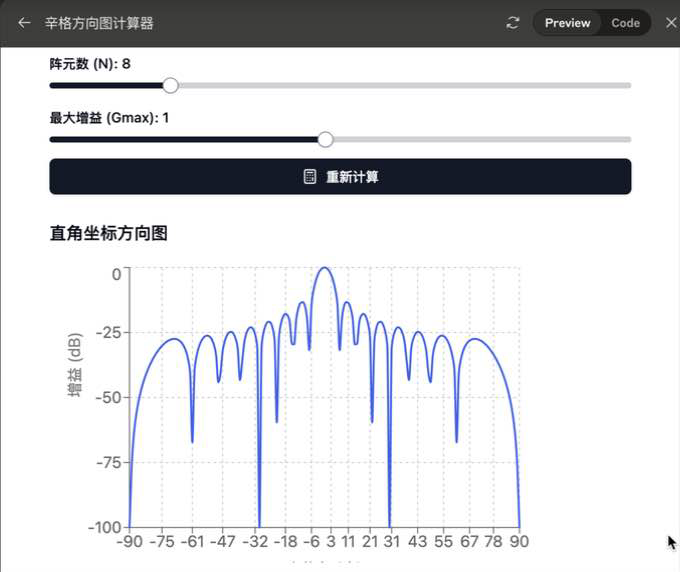
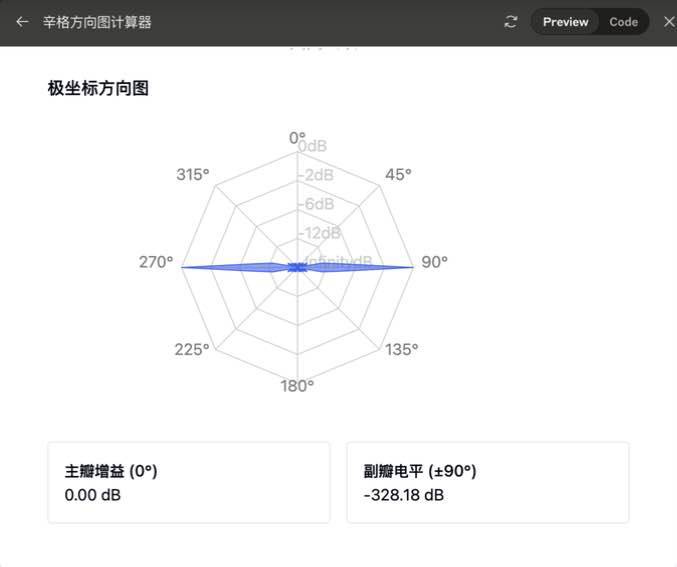
测试计算器代码:
import React, { useState } from 'react';
import { Card, CardHeader, CardTitle, CardContent } from '@/components/ui/card';
import { LineChart, Line, XAxis, YAxis, CartesianGrid, Tooltip, Legend, PolarGrid, PolarAngleAxis, PolarRadiusAxis, RadarChart, Radar } from 'recharts';
import { Slider } from '@/components/ui/slider';
import { Button } from '@/components/ui/button';
import { Label } from '@/components/ui/label';
import { CalculatorIcon } from 'lucide-react';

const SincCalculator = () => {
  const [N, setN] = useState(8);
  const [tempN, setTempN] = useState(8);
  const [Gmax, setGmax] = useState(1);
  const [tempGmax, setTempGmax] = useState(1);
  const [cartesianData, setCartesianData] = useState([]);
  const [polarData, setPolarData] = useState([]);

  // 关键方位角定义
  const keyAngles = [0, 45, 90, 135, 180, 225, 270, 315];

  const calculateGain = (theta, N, Gmax) => {
    const thetaRad = (theta * Math.PI) / 180;
    const sinTheta = Math.sin(thetaRad);

    if (Math.abs(sinTheta) < 1e-10) {
      return Gmax;
    }

    const numerator = Math.sin(N * Math.PI * sinTheta);
    const denominator = N * Math.PI * sinTheta;
    return Gmax * Math.pow(numerator / denominator, 2);
  };

  const updateData = () => {
    const newCartesianData = [];
    const newPolarData = [];

    // 更新直角坐标数据
    for (let theta = -90; theta <= 90; theta += 1) {
      const gain = calculateGain(theta, tempN, tempGmax);
      const gainDB = 10 * Math.log10(Math.max(gain, 1e-10));
      newCartesianData.push({
        theta,
        gain: gainDB
      });
    }

    // 更新极坐标数据
    for (let theta = 0; theta < 360; theta += 5) {
      // 对于大于180度的角度,使用对称性计算
      const calcTheta = theta <= 180 ? theta - 90 : 270 - theta;
      const gain = calculateGain(calcTheta, tempN, tempGmax);
      const gainDB = 10 * Math.log10(Math.max(gain, 1e-10));
      const normalizedGain = Math.pow(10, gainDB/20);
      newPolarData.push({
        theta,
        gain: normalizedGain,
        gainDB
      });
    }

    setCartesianData(newCartesianData);
    setPolarData(newPolarData);
    setN(tempN);
    setGmax(tempGmax);
  };

  // 自定义角度轴刻度格式化
  const formatPolarAngle = (angleValue) => {
    // 只有关键角度才显示标签
    if (keyAngles.includes(angleValue)) {
      return `${angleValue}°`;
    }
    return '';
  };

  return (
    <Card className="w-full max-w-4xl p-6">
      <CardHeader>
        <CardTitle>辛格方向图计算器</CardTitle>
      </CardHeader>
      <CardContent>
        <div className="space-y-6">
          {/* 参数控制区 */}
          <div className="space-y-4">
            <div className="space-y-2">
              <Label>阵元数 (N): {tempN}</Label>
              <Slider
                value={[tempN]}
                min={2}
                max={32}
                step={1}
                onValueChange={(value) => setTempN(value[0])}
                className="w-full"
              />
            </div>
            <div className="space-y-2">
              <Label>最大增益 (Gmax): {tempGmax}</Label>
              <Slider
                value={[tempGmax]}
                min={0.1}
                max={2}
                step={0.1}
                onValueChange={(value) => setTempGmax(value[0])}
                className="w-full"
              />
            </div>
            <Button
              onClick={updateData}
              className="w-full"
            >
              <CalculatorIcon className="w-4 h-4 mr-2" />
              重新计算
            </Button>
          </div>

          <div className="grid grid-cols-1 md:grid-cols-2 gap-6">
            {/* 直角坐标图 */}
            <div className="w-full overflow-x-auto">
              <h3 className="text-lg font-medium mb-4">直角坐标方向图</h3>
              <LineChart
                width={500}
                height={300}
                data={cartesianData}
                margin={{
                  top: 5,
                  right: 30,
                  left: 20,
                  bottom: 5,
                }}
              >
                <CartesianGrid strokeDasharray="3 3" />
                <XAxis
                  dataKey="theta"
                  label={{ value: '方位角 (度)', position: 'bottom' }}
                />
                <YAxis
                  label={{
                    value: '增益 (dB)',
                    angle: -90,
                    position: 'insideLeft'
                  }}
                  domain={[-40, 0]}
                />
                <Tooltip />
                <Line
                  type="monotone"
                  dataKey="gain"
                  stroke="#2563eb"
                  dot={false}
                  strokeWidth={2}
                />
              </LineChart>
            </div>

            {/* 极坐标图 */}
            <div className="w-full overflow-x-auto">
              <h3 className="text-lg font-medium mb-4">极坐标方向图</h3>
              <RadarChart
                width={500}
                height={300}
                data={polarData}
                cx="50%"
                cy="50%"
              >
                <PolarGrid />
                <PolarAngleAxis
                  dataKey="theta"
                  tickFormatter={formatPolarAngle}
                  ticks={keyAngles}
                />
                <PolarRadiusAxis
                  angle={90}
                  domain={[0, 1]}
                  tickFormatter={(value) => `${(20 * Math.log10(value)).toFixed(0)}dB`}
                />
                <Radar
                  name="增益"
                  dataKey="gain"
                  stroke="#2563eb"
                  fill="#2563eb"
                  fillOpacity={0.6}
                />
                <Tooltip
                  formatter={(value, name, props) => [
                    `${(20 * Math.log10(value)).toFixed(2)} dB`,
                    '增益'
                  ]}
                />
              </RadarChart>
            </div>
          </div>

          {/* 关键点数据显示 */}
          <div className="grid grid-cols-2 gap-4 mt-4">
            <div className="p-4 border rounded">
              <h3 className="font-medium">主瓣增益 (0°)</h3>
              <p>{(10 * Math.log10(calculateGain(0, N, Gmax))).toFixed(2)} dB</p>
            </div>
            <div className="p-4 border rounded">
              <h3 className="font-medium">副瓣电平 (±90°)</h3>
              <p>{(10 * Math.log10(calculateGain(90, N, Gmax))).toFixed(2)} dB</p>
            </div>
          </div>
        </div>
      </CardContent>
    </Card>
  );
};

export default SincCalculator;
三、模型代码
Python代码
用于测试和可视化辛格方向图模型的代码。这个代码将展示不同阵元数对方向图的影响。
import numpy as np
import matplotlib.pyplot as plt

def calc_sinc_pattern(theta_deg, N, G_max=1.0):
    """
    计算辛格方向图模型的增益

    参数:
    theta_deg: ndarray, 观察角度(度)
    N: int, 天线阵元数
    G_max: float, 最大增益

    返回:
    ndarray: 对应角度的增益值
    """
    # 将角度转换为弧度
    theta_rad = np.deg2rad(theta_deg)

    # 避免除零错误
    sin_theta = np.sin(theta_rad)
    numerator = np.sin(N * np.pi * sin_theta)
    denominator = N * np.pi * sin_theta

    # 处理 theta = 0 的特殊情况
    zero_indices = np.where(np.abs(sin_theta) < 1e-10)
    result = np.zeros_like(theta_deg, dtype=float)

    # 计算非零角度的增益
    nonzero_indices = np.where(np.abs(sin_theta) >= 1e-10)
    result[nonzero_indices] = G_max * (numerator[nonzero_indices] / denominator[nonzero_indices]) ** 2

    # 设置零角度的增益为最大值
    result[zero_indices] = G_max

    return result

def plot_pattern(N_values):
    """
    绘制不同阵元数的方向图

    参数:
    N_values: list, 要比较的阵元数列表
    """
    # 创建角度数组(-90度到90度)
    theta = np.linspace(-90, 90, 1000)

    # 设置图形样式
    plt.figure(figsize=(12, 8))
    plt.grid(True, linestyle='--', alpha=0.7)

    # 为每个阵元数绘制方向图
    for N in N_values:
        gain_db = 10 * np.log10(calc_sinc_pattern(theta, N))
        plt.plot(theta, gain_db, label=f'N={N}')

    # 设置图形属性
    plt.xlabel('方位角 (度)')
    plt.ylabel('增益 (dB)')
    plt.title('辛格方向图模型 - 不同阵元数比较')
    plt.legend()
    plt.ylim(-40, 0)  # 限制最小增益为-40dB
    plt.show()

def test_pattern():
    """
    测试函数:验证方向图的关键特性
    """
    # 测试不同阵元数和角度的组合
    N_test = [4, 8, 16]
    theta_test = np.array([0, 30, 60])

    print("辛格方向图模型测试结果:")
    print("-" * 50)

    for N in N_test:
        print(f"\n阵元数 N = {N}")
        gains = calc_sinc_pattern(theta_test, N)
        gains_db = 10 * np.log10(gains)

        for theta, gain, gain_db in zip(theta_test, gains, gains_db):
            print(f"角度: {theta:3.0f}° | 增益: {gain:.4f} | 增益(dB): {gain_db:.2f} dB")

# 运行测试
if __name__ == "__main__":
    # 执行数值测试
    test_pattern()

    # 绘制不同阵元数的方向图比较
    plot_pattern([4, 8, 16])
以上代码实现了以下功能:
calc_sinc_pattern函数:- 实现了辛格方向图的数学模型
- 处理了零角度的特殊情况
-
支持向量化计算,提高效率
-
plot_pattern函数: - 绘制极坐标形式的方向图
- 支持多个阵元数的对比
-
使用 dB 单位显示增益
-
test_pattern函数: - 验证不同角度和阵元数的组合
- 输出详细的测试结果
要运行这个代码,需要安装 NumPy 和 Matplotlib 库。运行后,将看到:
1. 控制台输出:显示不同阵元数和角度组合的具体增益值
2. 图形输出:展示不同阵元数的方向图对比
你可以通过修改 N_values 和测试角度来探索不同的参数组合。需要特别注意的是:
- 增益值已经归一化,最大值为1(0 dB)
- 图表中使用了 dB 单位以better展示旁瓣特性
- 程序处理了 θ = 0° 时的奇异点
C++代码
以下为一个易于集成的C++辛格方向图计算模块,包含清晰的输入输出接口。
// SincDirectionalModel.hpp
#ifndef SINC_DIRECTIONAL_MODEL_HPP
#define SINC_DIRECTIONAL_MODEL_HPP

#include <vector>
#include <cmath>
#include <stdexcept>

namespace DirectionalModel {

/**
 * @brief 辛格方向图计算模块
 * 用于计算和分析天线的辛格方向图特性
 */
class SincDirectionalModel {
public:
    /**
     * @brief 构造函数
     * @param elementCount 天线阵元数
     * @param maxGain 最大增益值
     * @throw std::invalid_argument 当参数无效时抛出异常
     */
    SincDirectionalModel(unsigned int elementCount = 8, double maxGain = 1.0);

    /**
     * @brief 设置天线阵元数
     * @param elementCount 天线阵元数
     * @return bool 设置是否成功
     */
    bool setElementCount(unsigned int elementCount);

    /**
     * @brief 设置最大增益
     * @param maxGain 最大增益值
     * @return bool 设置是否成功
     */
    bool setMaxGain(double maxGain);

    /**
     * @brief 计算指定角度的增益
     * @param angle_deg 观察角度(度)
     * @return double 增益值
     */
    double calculateGain(double angle_deg) const;

    /**
     * @brief 计算指定角度的分贝增益
     * @param angle_deg 观察角度(度)
     * @return double 分贝增益值
     */
    double calculateGainDB(double angle_deg) const;

    /**
     * @brief 生成方向图数据点
     * @param startAngle 起始角度(度)
     * @param endAngle 结束角度(度)
     * @param stepSize 角度步长(度)
     * @return std::vector<std::pair<double, double>> 角度-增益对
     */
    std::vector<std::pair<double, double>> generatePattern(
        double startAngle = -90.0,
        double endAngle = 90.0,
        double stepSize = 1.0) const;

    /**
     * @brief 生成分贝方向图数据点
     * @param startAngle 起始角度(度)
     * @param endAngle 结束角度(度)
     * @param stepSize 角度步长(度)
     * @return std::vector<std::pair<double, double>> 角度-分贝增益对
     */
    std::vector<std::pair<double, double>> generatePatternDB(
        double startAngle = -90.0,
        double endAngle = 90.0,
        double stepSize = 1.0) const;

    /**
     * @brief 获取天线关键参数
     * @return std::pair<double, double> 主瓣增益(dB)和第一旁瓣电平(dB)
     */
    std::pair<double, double> getKeyParameters() const;

private:
    unsigned int N_;      // 天线阵元数
    double Gmax_;        // 最大增益
    const double PI = 3.14159265358979323846;

    // 检查角度参数是否有效
    bool validateAngleParams(double start, double end, double step) const;
};

} // namespace DirectionalModel

#endif // SINC_DIRECTIONAL_MODEL_HPP

// SincDirectionalModel.cpp
#include "SincDirectionalModel.hpp"

namespace DirectionalModel {

SincDirectionalModel::SincDirectionalModel(unsigned int elementCount, double maxGain) {
    if (!setElementCount(elementCount) || !setMaxGain(maxGain)) {
        throw std::invalid_argument("Invalid constructor parameters");
    }
}

bool SincDirectionalModel::setElementCount(unsigned int elementCount) {
    if (elementCount < 1) return false;
    N_ = elementCount;
    return true;
}

bool SincDirectionalModel::setMaxGain(double maxGain) {
    if (maxGain <= 0) return false;
    Gmax_ = maxGain;
    return true;
}

double SincDirectionalModel::calculateGain(double angle_deg) const {
    // 转换为弧度
    double angle_rad = angle_deg * PI / 180.0;
    double sin_theta = std::sin(angle_rad);

    // 处理零角度特殊情况
    if (std::abs(sin_theta) < 1e-10) {
        return Gmax_;
    }

    double numerator = std::sin(N_ * PI * sin_theta);
    double denominator = N_ * PI * sin_theta;
    return Gmax_ * std::pow(numerator / denominator, 2);
}

double SincDirectionalModel::calculateGainDB(double angle_deg) const {
    double gain = calculateGain(angle_deg);
    // 防止取对数时出错,设置最小值
    gain = std::max(gain, 1e-10);
    return 10.0 * std::log10(gain);
}

bool SincDirectionalModel::validateAngleParams(double start, double end, double step) const {
    if (start >= end || step <= 0) return false;
    if (std::abs(step) > std::abs(end - start)) return false;
    return true;
}

std::vector<std::pair<double, double>> SincDirectionalModel::generatePattern(
    double startAngle, double endAngle, double stepSize) const {

    if (!validateAngleParams(startAngle, endAngle, stepSize)) {
        throw std::invalid_argument("Invalid angle parameters");
    }

    std::vector<std::pair<double, double>> pattern;
    pattern.reserve(static_cast<size_t>((endAngle - startAngle) / stepSize) + 1);

    for (double angle = startAngle; angle <= endAngle; angle += stepSize) {
        pattern.emplace_back(angle, calculateGain(angle));
    }

    return pattern;
}

std::vector<std::pair<double, double>> SincDirectionalModel::generatePatternDB(
    double startAngle, double endAngle, double stepSize) const {

    if (!validateAngleParams(startAngle, endAngle, stepSize)) {
        throw std::invalid_argument("Invalid angle parameters");
    }

    std::vector<std::pair<double, double>> pattern;
    pattern.reserve(static_cast<size_t>((endAngle - startAngle) / stepSize) + 1);

    for (double angle = startAngle; angle <= endAngle; angle += stepSize) {
        pattern.emplace_back(angle, calculateGainDB(angle));
    }

    return pattern;
}

std::pair<double, double> SincDirectionalModel::getKeyParameters() const {
    double mainLobeGainDB = calculateGainDB(0.0);

    // 查找第一旁瓣
    double firstSidelobeLevel = -std::numeric_limits<double>::infinity();
    double angle = 0.0;
    bool foundFirstPeak = false;

    while (angle <= 90.0) {
        double currentGain = calculateGainDB(angle);
        double nextGain = calculateGainDB(angle + 0.1);

        if (currentGain > nextGain && foundFirstPeak) {
            firstSidelobeLevel = currentGain;
            break;
        }

        if (currentGain < nextGain) {
            foundFirstPeak = true;
        }

        angle += 0.1;
    }

    return {mainLobeGainDB, firstSidelobeLevel};
}

} // namespace DirectionalModel
这个模块提供了以下主要功能:
- 类接口设计:
- 清晰的构造函数和设置函数
- 完整的错误检查和异常处理
-
命名空间封装
-
核心功能:
calculateGain: 计算指定角度的增益calculateGainDB: 计算分贝形式的增益generatePattern: 生成方向图数据点-
generatePatternDB: 生成分贝形式的方向图数据点 -
辅助功能:
getKeyParameters: 获取主瓣增益和第一旁瓣电平- 参数验证和错误处理
使用示例:
#include "SincDirectionalModel.hpp"
#include <iostream>

int main() {
    try {
        // 创建模型实例:8个阵元,最大增益1.0
        DirectionalModel::SincDirectionalModel model(8, 1.0);

        // 计算单点增益
        double gain_0deg = model.calculateGainDB(0.0);
        std::cout << "0度增益: " << gain_0deg << " dB\n";

        // 生成方向图数据
        auto pattern = model.generatePatternDB(-90.0, 90.0, 1.0);

        // 获取关键参数
        auto [mainLobe, sidelobe] = model.getKeyParameters();
        std::cout << "主瓣增益: " << mainLobe << " dB\n";
        std::cout << "第一旁瓣电平: " << sidelobe << " dB\n";

    } catch (const std::exception& e) {
        std::cerr << "Error: " << e.what() << std::endl;
        return 1;
    }

    return 0;
}
集成建议:
- 将头文件和源文件添加到项目中
- 包含头文件并使用
DirectionalModel命名空间 - 根据需要调用相应的方法
- 注意处理可能的异常