附录A:问题解答
为响应众多请求,本附录收录了来自《EW 101》和《EW 102》两本书中的问题。每个问题的解答均以 \(1-\mathrm{dB}\) 的分辨率计算,并使用相应的公式形式。当需要使用教材中的诺模图或图表时,将其复制并展示如何利用其求解问题。
当题目中给出天线增益时,除非另有说明,否则均指发射天线在朝向接收机方向上的增益(dBi),以及接收天线在朝向发射机方向上的增益(dBi)。
在这些问题和解答中,“log”表示以 \(10\) 为底的对数(\(\log_{10}\))。
请记住,分贝公式要求输入量必须采用正确的单位。这些单位在参考章节的公式中已经给出。
第1部分 来自《EW 101》书籍的问题
以下问题均来自《EW 101》中的内容。所列的章节号对应《EW 101》中给出公式和解释的章节。
问题101-1: 将 4 W 转换为 dBm。
\[
\begin{aligned}
4 \mathrm{~W} / 1 \mathrm{~mW} & =4,000 \\
10 \log _{10}(4,000) & =36 \mathrm{dBm}
\end{aligned}
\]
问题101-2: 将 70 dBW 转换为 dBm。
\[
\begin{gathered}
1 \mathrm{~W}=1,000 \mathrm{~mW} \\
10 \log (1,000)=30 \mathrm{~dB} \\
70 \mathrm{dBW}+30 \mathrm{~dB}=100 \mathrm{dBm}
\end{gathered}
\]
问题101-3: 计算 \(1-\mathrm{GHz}\) 信号在 50 km 距离下的视距扩散损耗。
\[
\begin{aligned}
L_{S} & =32+20 \log (d)+20 \log (F) \\
& =32+20 \log (50)+20 \log (1,000) \\
& =32+34+60=-126 \mathrm{~dB}
\end{aligned}
\]
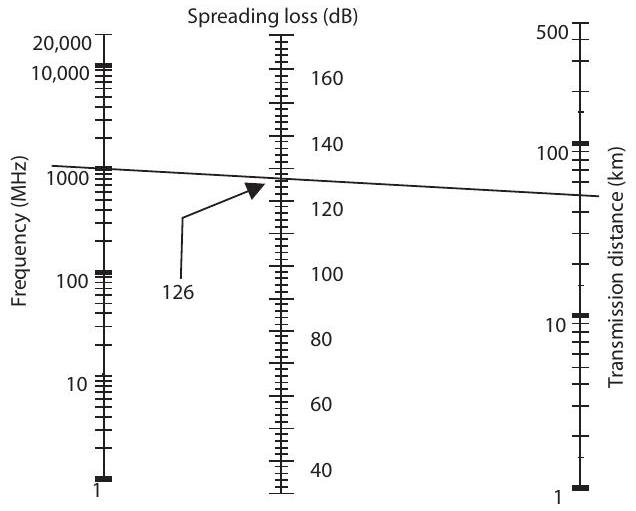
或者,使用图2.2中的诺模图:
从频率(单位:MHz)到距离(单位:km)画一条直线。
该直线与中心刻度(扩散损耗,单位:dB)相交于 126 dB 处。
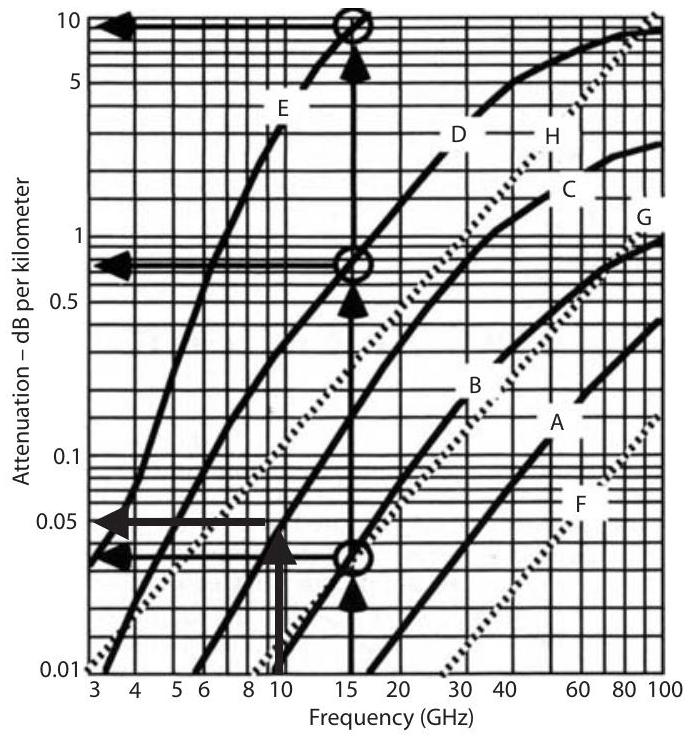
问题101-4: 求 \(10-\mathrm{GHz}\) 信号在 20 km 距离下的大气衰减。
此题需使用图2.3中的曲线图。
从横坐标(对数刻度)上取频率 15 GHz。注意这是对数刻度,因此 15 大约位于 10 与 20 之间的 0.7 处。向上找到曲线,再向左投影到纵坐标。读数为每公里 0.04 dB。
由于距离为 20 km,大气衰减为:
$$
0.04 \times 20 = 0.8 \ \mathrm{dB}
$$
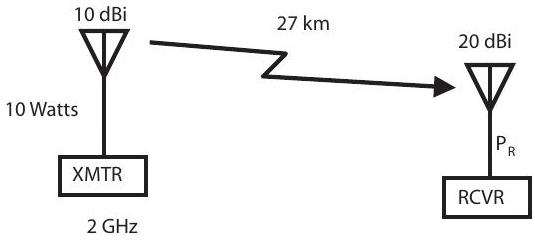
问题101-5: 计算一台 \(2-\mathrm{GHz}\)、10 W 发射机在朝向接收机方向上天线增益为 10 dB 的情况下,接收机在 27 km 处接收到的信号强度。接收天线在朝向发射机方向上的增益为 20 dB。
\[
\begin{gathered}
10 \mathrm{~W}=10,000 \mathrm{mw} \\
10 \log (10,000 \mathrm{mw})=+40 \mathrm{dBm}
\end{gathered}
\]

\[
\begin{aligned}
P_{R} & =P_{T}+G_{T}-32-20 \log (d)-20 \log (F)+G_{R} \\
& =+40+10-32-20 \log (27)-20 \log (10,000)+20 \\
& =40+10-32-29-80+20=-71 \mathrm{dBm}
\end{aligned}
\]
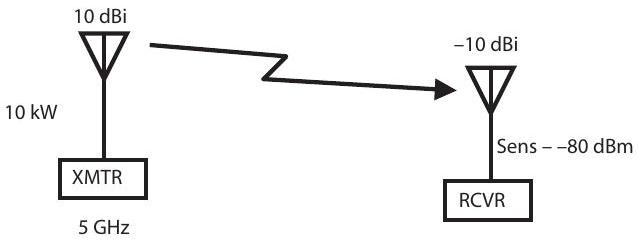
问题101-6: 求一个接收机在灵敏度为 -80 dBm、接收天线在指向发射机方向上的增益为 -10 dBi 时,能够接收到来自一台 \(5-\mathrm{GHz}\)、发射功率 \(100-\mathrm{kW}\)、天线在指向接收机方向上的增益为 10 dB 的发射机信号的最大距离。
\[
\begin{gathered}
100 \mathrm{~kW}=100,000,000 \mathrm{mw} \\
10 \log (100,000,000)=+80 \mathrm{dBm}
\end{gathered}
\]
\[
\text{设 } P_{R}=\text{Sens}=P_{T}+G_{T}-32-20 \log (d)-20 \log (F)+G_{R}
\]
解得:
$$
20 \log (d)=P_{T}+G_{T}-32-20 \log (F)+G_{R}-\text{Sens}
$$
\[
\begin{aligned}
& =+80+10-32-20 \log (5,000)+(-10)-(-80) \\
& =+80+10-32-74-10+80 \\
& =54
\end{aligned}
\]
\[
d=\operatorname{antilog}(54 / 20)=\operatorname{antilog}(2.7)=501 \mathrm{~km}
\]
问题101-7: 若某接收机的规格为在 100 MHz 下灵敏度为 \(1 \ \mu \mathrm{V}/\mathrm{m}\),求其在 dBm 下的灵敏度。
\[
\begin{aligned}
P & =-77+20 \log (E)-20 \log (F) \\
& =-77+20 \log (1)-20 \log (100) \\
& =-77+0-40=-117 \mathrm{dBm}
\end{aligned}
\]
问题101-8: 若某接收机在 50 MHz 下灵敏度为 -100 dBm,求其对应的电场强度(单位:\(\mu \mathrm{V}/\mathrm{m}\))。
\[
\begin{aligned}
E & =\text{antilog}\{[P+77+20 \log (F)] / 20\} \\
& =\text{antilog}\{[-100+77+34] / 20\} \\
& =\text{antilog}\{0.55\}=3.5 \mu \mathrm{V}/\mathrm{m}
\end{aligned}
\]
问题101-9: 若雷达发射机功率为 10 kW,天线增益为 30 dBi,频率为 10 GHz,目标距离 25 km,目标雷达散射截面(RCS)为 \(20 \ \mathrm{m}^{2}\),求接收机接收到的功率。
\[
\begin{aligned}
P_{R} & =P_{T}+2 G-103-40 \log (D)-20 \log (F)+10 \log (\mathrm{RCS}) \\
P_{T} & =10 \ \mathrm{kw} \quad 10 \log (100,000,000)=+70 \mathrm{dBm} \\
40 \log (D) & =40 \log (25)=56 \\
20 \log (F) & =20 \log (10,000)=80 \\
10 \log (\mathrm{RCS}) & =10 \log (20)=13 \\
P_{R} & =70+60-103-56-80+13=-96 \mathrm{dBm}
\end{aligned}
\]
问题101-10: 一台发射机位于地面上方 2 m,高度为 1000 m 的接收机接收 \(100-\mathrm{MHz}\) 信号。求其弗涅尔区(FZ)距离。
\[
\begin{aligned}
\mathrm{FZ} & =\left(h_{T} \times h_{R} \times f\right) / 24,000 \\
& =2 \times 1,000 \times 100 / 24,000=8.3 \mathrm{~km}
\end{aligned}
\]
请注意:在部分《EW 101》的印刷版本中,该公式存在错误。书中写为除以 75,000,实际上正确的除数(近似取整后)应为 24,000。
另一种 FZ 的公式为:
\[
\mathrm{FZ}=4 \pi \times h_{T} \times h_{R} / \lambda
\]
\(100-\mathrm{MHz}\) 信号的波长为:
$$
3 \times 10^{8} \ \mathrm{m/s} / 10^{8} \ \mathrm{Hz}=3 \ \mathrm{m}
$$
\[
4 \pi \times 2 \times 1,000 / 3=8,377 \ \mathrm{m}
\]
该结果更加精确,因为 24,000 是为简便而进行的取整。
问题101-11: 使用双径模型,求一台发射天线高度为 2 m、接收天线高度为 1000 m、频率为 \(100-\mathrm{MHz}\) 的信号在 25 km 距离下的扩散损耗。
注意:双径模型适用,因为(如问题101-10所算)FZ距离小于传输距离。
\[
\begin{aligned}
L_{S} & =120+40 \log (d)-20 \log \left(h_{T}\right)-20 \log \left(h_{R}\right) \\
& =120+40 \log (25)-20 \log (2)-20 \log (1,000) \\
& =120+56-6-60=110 \mathrm{~dB}
\end{aligned}
\]
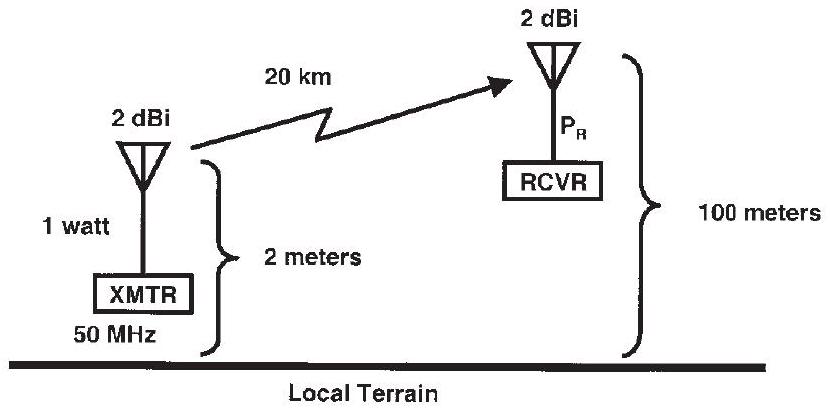
问题101-12: 一台 \(1-\mathrm{W}\)、\(50-\mathrm{MHz}\) 的发射机,天线增益为 2 dB,天线高度 2 m;接收机天线高度为 100 m,天线增益为 2 dB,距离 20 km。求接收机的接收功率。
\[
\mathrm{FZ}=2 \times 100 \times 50 / 24,000=0.417 \mathrm{~km}
\]
链路长度大于 FZ 距离,因此应使用双径模型。
\[
\begin{aligned}
P_{R} &=P_{T}+G_{T}-\left[120+40 \log (d)-20 \log \left(h_{T}\right)-20 \log \left(h_{R}\right)\right]+G_{R} \\
& =+30 \mathrm{dBm}+2 \mathrm{~dB}-120-40 \log (20)+20 \log (2)+20 \log (100)+2 \mathrm{~dB} \\
& =30+2-120-52+6+40+2=-92 \mathrm{dBm}
\end{aligned}
\]
问题101-13: 在一个球面三角形中(大写字母表示角,小写字母表示与对应角相对的边),若 \(a=35^{\circ}\),\(A=42^{\circ}\),\(B=52^{\circ}\),求边 \(b\) 的值。
在任意球面三角形中,有关系式:
$$
\sin (a) / \sin (A)=\sin (b) / \sin (B)=\sin (c) / \sin (C)
$$
\[
\begin{aligned}
\sin (b) &=\sin (a) \times \sin (B) / \sin (A) \\
b &=\arcsin [\sin (a) \times \sin (B) / \sin (A)] \\
&=\arcsin [0.574 \times 0.788 / 0.669]=\arcsin [0.676]=42.5^{\circ}
\end{aligned}
\]

问题101-14: 在同一个球面三角形中,若 \(b=37^{\circ}\),\(c=45^{\circ}\),\(A=67^{\circ}\),求边 \(a\)。
\[
\begin{aligned}
\cos (a)&=\cos (b) \times \cos (c)+\sin (b) \times \sin (c) \times \cos (A) \\
a&=\arccos [\cos (b) \times \cos (c)+\sin (b) \times \sin (c) \times \cos (A)] \\
&=\arccos [0.799 \times 0.707+0.602 \times 0.707 \times 0.391] \\
&=\arccos [0.731]=43.0^{\circ}
\end{aligned}
\]
问题101-15: 在同一个球面三角形中,若 \(A=120^{\circ}\),\(B=35^{\circ}\),\(c=50^{\circ}\),求角 \(C\)。
\[
\begin{aligned}
\cos (C)&=-\cos (A) \times \cos (B)+\sin (A) \times \sin (B) \times \cos (c) \\
C&=\arccos [-\cos (A) \times \cos (B)+\sin (A) \times \sin (B) \times \cos (c)] \\
&=\arccos [0.5 \times 0.819+0.866 \times 0.574 \times 0.643] \\
&=\arccos [0.729]=43.2^{\circ}
\end{aligned}
\]
问题101-16: 在一个直角球面三角形中,若边 \(c\) 对应于直角 \(90^{\circ}\),另外两边为 \(a\) 和 \(b\),角 \(A\) 和 \(B\) 分别为与之相对的角。若 \(a=47^{\circ}\),\(b=85^{\circ}\),求边 \(c\)。
\[
\begin{aligned}
& \cos (c)=\cos (a) \times \cos (b) \\
& c=\arccos [\cos (a) \times \cos (b)] \\
& =\arccos [0.682 \times 0.087]=\arccos [0.059]=86.6^{\circ}
\end{aligned}
\]
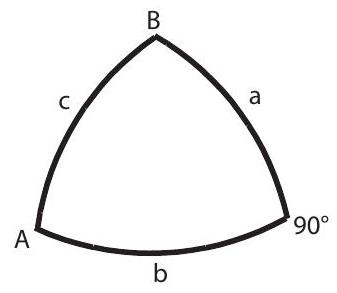
问题101-17: 在同一三角形中,若 \(A=80^{\circ}\) 且 \(b=44^{\circ}\),求边 \(c\)。
\[
\begin{aligned}
& \cos (A)=\tan (b) \times \operatorname{ctn}(c) \\
& \operatorname{ctn}(c)=\cos (A) / \tan (b)
\end{aligned}
\]
注意 \(\operatorname{ctn}=1/\tan\)(方便的是计算器没有 ctn 函数)。
\[
\begin{aligned}
& \text{因此 } \tan (c)=\tan (b) / \cos (A) \\
& c=\arctan [\tan (b) / \cos (A)] \\
& =\arctan [0.966 /(0.174)]=\arctan [5.563]=79.8^{\circ}
\end{aligned}
\]
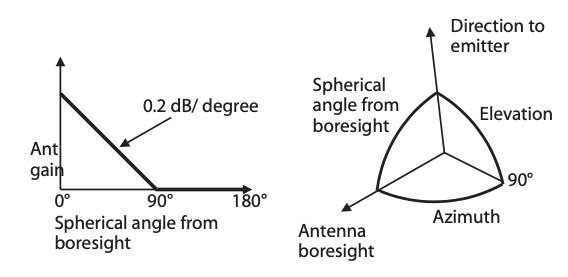
问题101-18: 一个雷达告警接收机象限天线的增益随着离开天线主轴(到 \(90^{\circ}\))每度降低 0.2 dB。某发射源相对于天线主轴的仰角为 \(42^{\circ}\),方位角为 \(65^{\circ}\)。求该天线朝向该发射源的增益相对于天线主轴增益的变化值。
首先,使用 Napier 的直角球面三角规则求出从主轴到发射源的球面角。
\[
\begin{aligned}
& \text{Spherical angle}=\arccos [\cos(\mathrm{Az}) \times \cos(\mathrm{El})] \\
& =\arccos [0.423 \times 743]=\arccos [0.314]=71.7^{\circ}
\end{aligned}
\]
相对于主轴的增益降低为:\(71.7^{\circ} \times 0.2\ \mathrm{dB/deg}=14.3\ \mathrm{dB}\)。
问题101-19: 求在一移动发射机向固定接收机发射的信号中的多普勒频移。发射机位置为北 5 km、东 7 km、上 1 km。接收机位置为北 25 km、东 15 km、上 2 km。发射机速度矢量为 \(150\ \mathrm{m/s}\),仰角 \(20^{\circ}\),方位角 \(5^{\circ}\)。发射频率为 \(10\ \mathrm{GHz}\)。
注意:东为正 \(X\) 方向,北为正 \(Y\) 方向,\(Z\) 为向上。
\[
\begin{aligned}
& A Z_{R}=\arctan \left[\left(X_{R}-X_{T}\right) /\left(Y_{R}-Y_{T}\right)\right]=\arctan [(15-7) /(25-5)] \\
& =\arctan [0.4]=21.8^{\circ} \\
& E l_{R}=\arctan \left\{\left(Z_{R}-Z_{T}\right) / \operatorname{sqrt}\left[\left(X_{R}-X_{T}\right)^{2}+\left(Y_{R}-Y_{T}\right)^{2}\right]\right\} \\
& =\arctan \left\{(2-1) / \operatorname{sqrt}\left[(15-7)^{2}+(25-5)^{2}\right]\right\}=\arctan \{2 / 21.5\} \\
& =\arctan \{0.093\}=5.3^{\circ}
\end{aligned}
\]
接着,利用图 2.14:
速度矢量相对于北方向的球面角为:
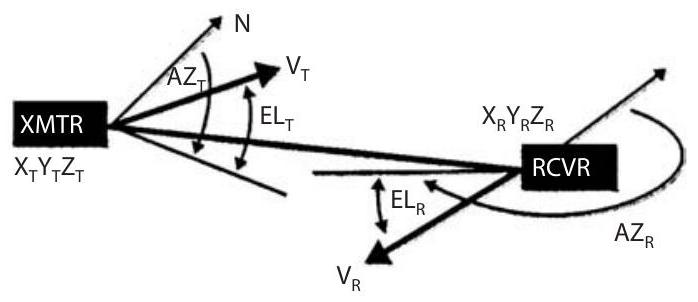

\[
\begin{aligned}
& \cos (d)=\cos \left(A z_{V}\right) \times \cos \left(E L_{V}\right) \\
& d=\arccos \left[\cos \left(A z_{V}\right) \times \cos \left(E L_{V}\right)\right]=\arccos \left[\cos \left(5^{\circ}\right) \times \cos \left(20^{\circ}\right)\right] \\
& =\arccos [0.996 \times 0.940]=\arccos [0.936]=20.6^{\circ} \\
& e=\arccos \left[\cos \left(A z_{R}\right) \times \cos \left(E l_{R}\right)\right]=\arccos \left[\cos \left(21.8^{\circ}\right) \times \cos \left(5.3^{\circ}\right)\right] \\
& =\arccos [0.925]=22.4^{\circ}
\end{aligned}
\]
角 \(A\) 和 \(B\) 可由下式得到:
\[
\begin{aligned}
& A=\operatorname{arc} \operatorname{ctn}\left[\sin \left(A z_{V}\right) / \tan \left(E l_{V}\right)\right]=\operatorname{arc} \operatorname{ctn}\left[\sin \left(5^{\circ}\right) / \tan \left(20^{\circ}\right)\right] \\
& =\operatorname{arc} \operatorname{ctn}[0.087 / 0.364]=\operatorname{arc} \operatorname{ctn}[0.239]=\operatorname{arc} \operatorname{ctn}[1 / 0.239] \\
& =\operatorname{arc} \operatorname{ctn}[4.18]=76.5^{\circ}
\end{aligned}
\]
\[
B=\operatorname{arc} \operatorname{ctn}\left[\sin \left(A z_{R}\right) / \tan \left(E L_{R}\right)\right]=\operatorname{arc} \operatorname{ctn}\left[\sin \left(21.8^{\circ}\right) / \tan (5.3)\right]
\]
\[
=\operatorname{arc} \operatorname{ctn}[0.371 / 0.0928]=\operatorname{arc} \operatorname{ctn}[4.0]=\arctan [0.250]=14.0^{\circ}
\]
角 \(C=A-B=76.5^{\circ}-14.0^{\circ}=62.5^{\circ}\)。
然后,速度矢量到接收机方向的球面角为:
\[
\begin{aligned}
& V R=\arccos [\cos (d) \times \cos (e)+\sin (d) \times \sin (e) \times \cos (C)] \\
& =\arccos \left[\cos \left(20.6^{\circ}\right) \times \cos \left(22.4^{\circ}\right)+\sin \left(20.6^{\circ}\right) \times \sin \left(22.4^{\circ}\right) \times \cos \left(62.5^{\circ}\right)\right] \\
& =\arccos [0.936 \times 0.925+0.352 \times 0.381 \times 0.462]=\arccos [0.928]=21.9^{\circ}
\end{aligned}
\]
发射机与接收机之间的相对径向速度为:
\[
V_{R E L}=V \cos (V R)=(150 \mathrm{~m} / \mathrm{s}) \times 0.928=139.2 \mathrm{~m} / \mathrm{s}
\]
多普勒频移为:
\[
\Delta f=f \times V_{R E L} / c=10^{10} \mathrm{~Hz} \times 139.2 \mathrm{~m} / \mathrm{s} / 3 \times 10^{8} \mathrm{~m} / \mathrm{s}=4,640 \mathrm{~Hz}
\]
问题101-20: 一副天线在 1 GHz 时的主轴方向增益为 30 dB,求其有效面积。
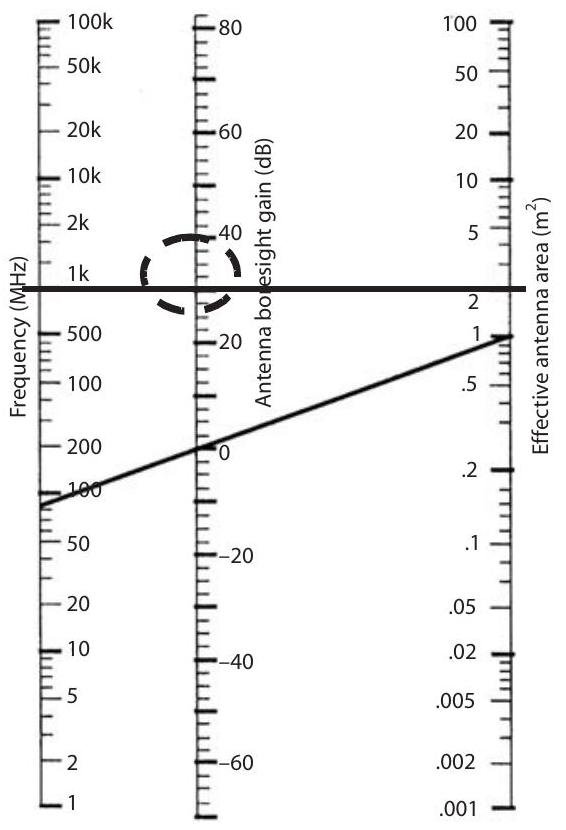
使用图3.5的诺模图。从 \(1\ \mathrm{K}\)(即 \(1,000\ \mathrm{MHz}\))在左侧刻度画一条直线通过中心刻度的 30 dB,然后在右侧刻度读取有效面积(平方米)。
\[
2\ \mathrm{m}^{2}
\]
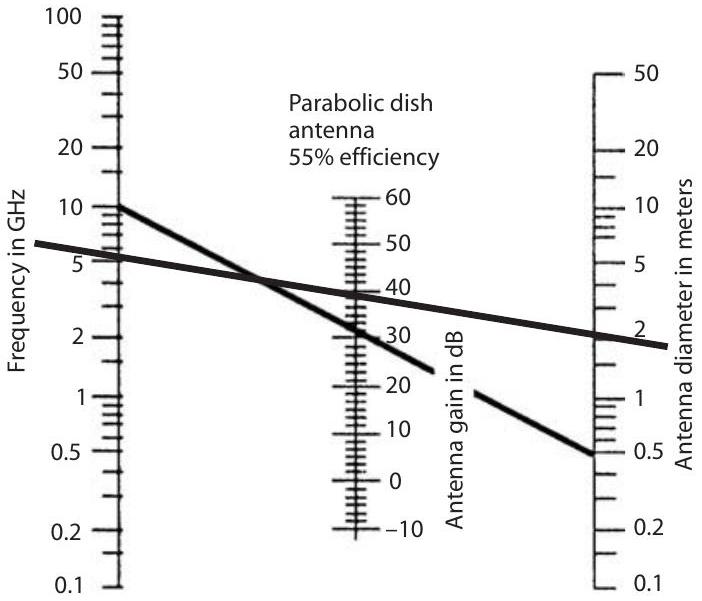
问题101-21: 一个效率为 \(55\%\) 的抛物面天线,直径 2 m,在 5 GHz 工作,其增益是多少?
使用图3.6的诺模图。从左侧刻度的 5 GHz 向右侧的 2 m 画一条直线,在中间刻度读取增益。
约为 38 dB。
问题101-22: 一个效率为 \(55\%\) 的抛物面天线,其 \(3\ \mathrm{dB}\) 波束宽度在仰角方向为 \(10^{\circ}\),方位方向为 \(25^{\circ}\),其增益是多少?
\[
\begin{aligned}
& \text{Gain(非以分贝表示)}=29,000/(10\times25)=116 \\
& \qquad\text{Gain(以分贝表示)}=10\log(116)=20.6\ \mathrm{dB}
\end{aligned}
\]
问题101-23: 一个接收机的带宽为 \(10\ \mathrm{MHz}\),噪声因子(Noise figure)\(=5\ \mathrm{dB}\),要求的信噪比 \(=13\ \mathrm{dB}\),其灵敏度是多少?
\[
\begin{aligned}
& kTB(\mathrm{dBm})=-114+10\log(\text{Bandwidth}/1\ \mathrm{MHz})=-114+10\log(10) \\
& =-114+10=-104\ \mathrm{dBm}
\end{aligned}
\]
\[
\begin{aligned}
& \text{Sensitivity}=kTB(\mathrm{dBm})+\mathrm{NF}(\mathrm{dB})+\mathrm{SNR}(\mathrm{dB}) \\
& =-104\ \mathrm{dBm}+5\ \mathrm{dB}+13\ \mathrm{dB}=-86\ \mathrm{dBm}
\end{aligned}
\]
问题101-24: 一个接收系统包含:噪声因子为 \(3\ \mathrm{dB}\) 的系统,前置放大器增益 \(25\ \mathrm{dB}\)。前置放大器之前的损耗 \(=1\ \mathrm{dB}\)。前置放大器与接收机之间的损耗 \(=13\ \mathrm{dB}\)。接收机本身的噪声因子 \(=10\ \mathrm{dB}\)。求该接收系统的整体噪声因子?
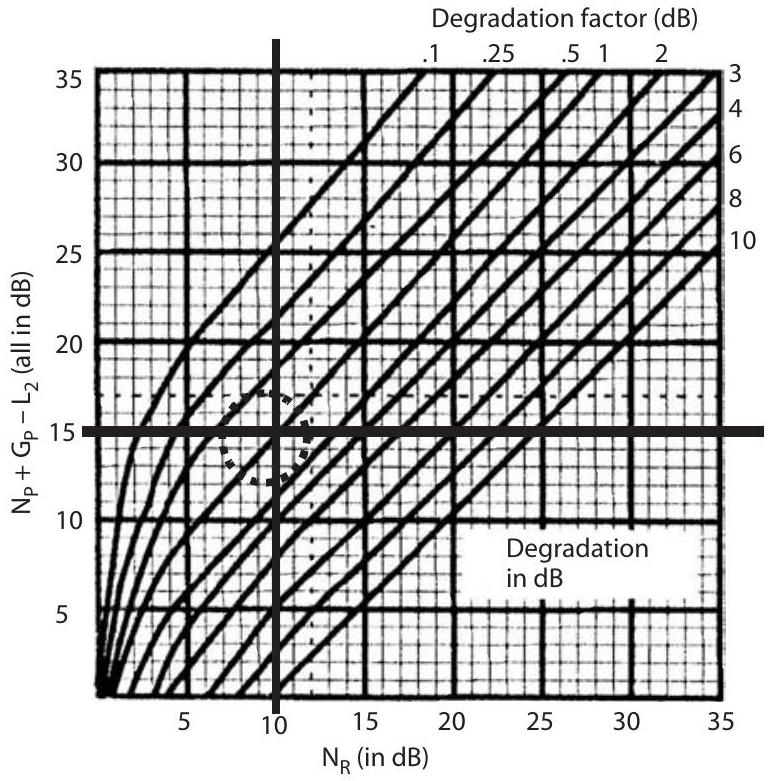
使用图4.17中的图表。
在纵轴上找到 “前置放大器增益 + 前置放大器噪声因子 - 接收机前的损耗” 的值:25 + 3 - 13 = 15。在该点画一条水平线。
在横轴上通过接收机噪声因子画一条垂直线。
这两条线在指示退化(本例为 1 dB)的曲线上相交。
系统噪声因子 = 接收机前的损耗 + 前置放大器噪声因子 + 退化
= 1 dB + 3 dB + 1 dB = 5 dB
问题101-25: 对于一个接收 FM 信号且使用锁相环鉴频器(phase locked loop discriminator)的系统,若调制度为 5,检波前信噪比为 4 dB,则检波后(postdiscrimination)信噪比是多少?
FM 在阈上方的改进因子为:
\[
IF_{FM}(\mathrm{dB})=5+20\log(\text{mod index})=5+20\log(5)=5+14=19
\]
因此检波后 SNR = 4 dB + 19 dB = 23 dB。
问题101-26: 若信号以每采样 5 位(5 bits/sample)进行量化,则检波后信噪比(实际上是信号-量化比,SQR)是多少?
\[
\begin{gathered}
\operatorname{SQR}(\mathrm{dB})=5+3(2m-1) \\
m=\text{bits/sample}=5 \\
\operatorname{SQR}(\mathrm{dB})=5+3(9)=32\ \mathrm{dB}
\end{gathered}
\]
问题101-27: 对于一个相干 PSK 调制信号,其 \(E_b/N_0\) 为 8 dB,误比特率(bit error rate)是多少?
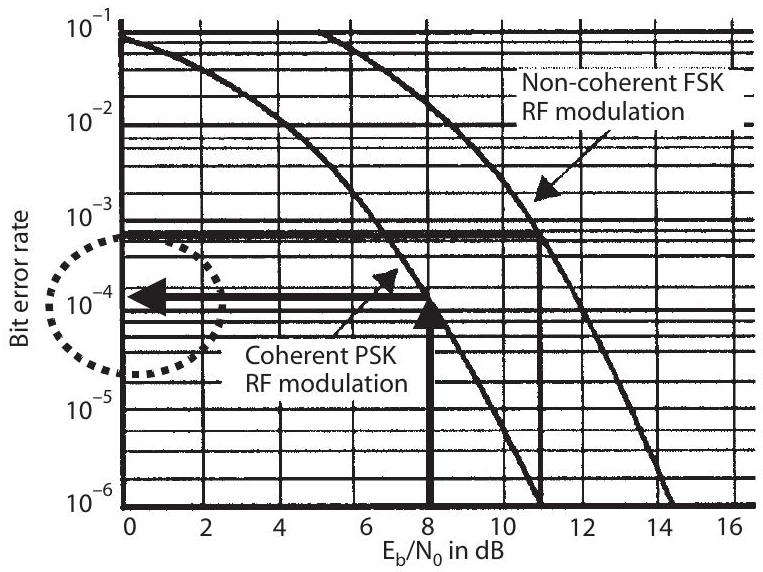
使用图4.20中的曲线。请注意该图横轴应标为 \(E_b/N_0\)(以分贝计)。
从横轴的 8 dB 处向上画一条竖线至相干 PSK 曲线,再向左到纵轴,读出约为 \(1.2\times 10^{-4}\) 的误比特率。
问题101-28: 一雷达信号,脉冲宽度 \(2\ \mu\text{s}\),脉冲重复频率(PRF) \(1000\ \text{pps}\)(每秒脉冲数),频率范围 2 到 4 GHz,波束宽度 \(5^{\circ}\),做圆形扫描,扫描周期 5 秒。接收机灵敏度足以接收雷达的整个 \(3\ \text{dB}\) 波束宽度,接收机带宽为 10 MHz。求该雷达在 1 秒内被拦截的概率(Probability of Intercept)。
允许的一秒时间从第一道脉冲到达接收天线时开始,因此我们必须求出在第一束波束通过时收到的信号。
波束宽度为 \(5^{\circ}\),威胁天线以 5 秒覆盖 \(360^{\circ}\),因此波束持续时间为 \(5\ \text{sec}\times(5/360)=69.4\ \mathrm{ms}\)。这意味着当波束扫过接收器时我们可以接收 69 个脉冲。
若以最大速率步进调谐,则我们的带宽必须在某一频点保持的时间等于 \(1/\text{bandwidth}\),即 100 ns。脉冲宽度为 \(2\ \mu\mathrm{s}\),因此我们可以在脉冲期间查看 20 次(覆盖 \(20\times10\ \mathrm{MHz}=200\ \mathrm{MHz}\))。拦截每一脉冲的概率为:
\[
\frac{200\ \mathrm{MHz}}{2000\ \mathrm{MHz}}=10\%
\]
如果我们在每个脉冲间隔(1 ms)内步进一个带宽,进行 69 个间隔,则我们将覆盖 \(69\times10\ \mathrm{MHz}=690\ \mathrm{MHz}\)。拦截 69 个脉冲中任一脉冲的概率为:
\[
\frac{690\ \mathrm{MHz}}{2000\ \mathrm{MHz}}=34.5\%
\]
注:下面的做法严格说超出了本书范围,但也可作为另一种解法。即当我们尽可能快地扫频并把 69 次视为独立尝试时,求至少得到一次脉冲的概率。至少一次成功的概率为:
\[
1-(1-p)^{69}
\]
其中 \(p\) 是一次尝试成功的概率。因 \(p=10\%\),所以 69 次尝试中至少成功一次的概率为 \(1-0.9^{69}=0.9993\),即 \(99.93\%\)。
问题101-29: 求发射天线高度为 100 m、接收机为机载、飞行高度 \(2,000\ \mathrm{m}\) 时的最大视距。假设为平滑 4/3 地球模型。
最大视距为:
\[
D=4.11\times\big[\sqrt{H_T}+\sqrt{H_R}\big]
\]
\(D\) 以千米为单位,\(H\) 值以米为单位。
\[
=4.11\times(10+44.7)=224.8\ \mathrm{km}
\]
问题101-30: 计算由一台 100 W 干扰机(天线增益 \(10\ \mathrm{dB}\)),位于距接收机 30 km 处,对接收机造成的 J/S(当期望发射机的有效辐射功率 ERP 为 1 W,距接收机 10 km,接收机使用鞭状天线,且与接收机具有直视通路时)。
\[
\mathrm{J}/\mathrm{S}=P_J-P_T+G_J-G_T-20\log(D_J)+20\log(D_S)+G_{RJ}-G_R
\]
\(P_T\) 与 \(G_T\) 的和即发射机 1 W 的 ERP \(=30\ \mathrm{dBm}\)。因为 \(G_{RJ}\) 与 \(G_R\) 相等,这两项相互抵消。所以:
\[
\begin{aligned}
\mathrm{J}/\mathrm{S} &= P_J+G_J-\mathrm{ERP}_T-20\log(D_J)+20\log(D_S) \\
&=+50+10-30-20\log(30)+20\log(10) \\
&=50+10-30-30+20=20\ \mathrm{dB}
\end{aligned}
\]
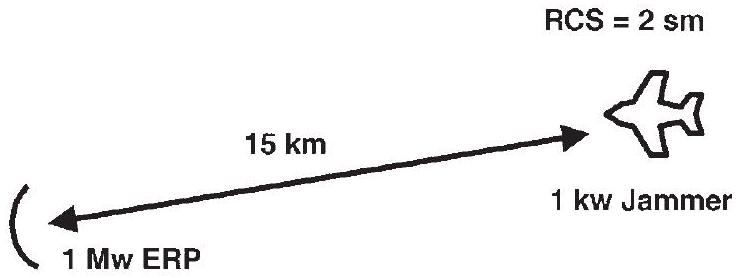
问题101-31: 计算一台自卫干扰机(自保干扰器)在距雷达 15 km 时所能实现的 J/S,已知该自卫干扰机有效辐射功率为 1 kW ERP,雷达 ERP 为 1 MW,目标的雷达截面积(RCS)为 \(2\ \mathrm{m}^{2}\)。
\[
\mathrm{J}/\mathrm{S}=71+P_J-P_T+G_J-G_R+20\log(D_T)-10\log(\mathrm{RCS})
\]
其中 \(P_J+G_J=\mathrm{ERP}_J\),\(P_T+G_T=\mathrm{ERP}_R\),\(1\ \mathrm{kW}=+60\ \mathrm{dBm}\),\(1\ \mathrm{MW}=+90\ \mathrm{dBm}\)。
因此:
\[
\begin{aligned}
\mathrm{J}/\mathrm{S} &=71+\mathrm{ERP}_J-\mathrm{ERP}_R+20\log(D_T)-10\log(\mathrm{RCS}) \\
&=71+60-90+20\log(15)-10\log(2) \\
&=71+60-90+24-3=62\ \mathrm{dB}
\end{aligned}
\]
问题101-32: 对上述雷达、干扰机和目标,若烧穿(burn-through)发生在 \(0\ \mathrm{dB}\) J/S 时,求烧穿距离。
首先,将 J/S 方程解出 \(20\log(D_T)\):
\[
\begin{gathered}
20 \log(D_T) = -71 - \mathrm{ERP}_J + \mathrm{ERP}_R + 10\log(\mathrm{RCS}) + \mathrm{J/S} \\
= -71 - 60 + 90 + 2 + 0 = -39 \\
D_T = \operatorname{antilog}[-39/20] = 0.0112\ \mathrm{km} = 112\ \mathrm{m}
\end{gathered}
\]
问题101-33: 计算一台远程干扰机(standoff jammer)在距雷达 25 km 处,对雷达造成的 J/S。干扰机发射功率 2 kW,天线增益 18 dB;雷达 ERP 1 MW,包括主波束天线增益 30 dBi;干扰机在雷达旁瓣 0 dBi;目标飞机距雷达 10 km,RCS 为 \(2\ \mathrm{m}^2\)。
\[
\mathrm{J}/\mathrm{S} = 71 + P_J - P_T + G_J + G_{RJ} - 2 G_R - 20 \log(D_J) + 40 \log(D_T) - 10 \log(\mathrm{RCS})
\]
\[
\begin{gathered}
1\ \mathrm{MW} = +90\ \mathrm{dBm},\quad 2\ \mathrm{kW} = +63\ \mathrm{dBm} \\
P_T = \mathrm{ERP}_R - G_R = +90\ \mathrm{dBm} - 30\ \mathrm{dB} = +60\ \mathrm{dBm}
\end{gathered}
\]
\[
\begin{aligned}
\mathrm{J}/\mathrm{S} &= 71 + 63 - 60 + 18 + 0 - 2(30) - 20 \log(25) + 40 \log(10) - 10 \log(2) \\
&= 71 + 63 - 60 + 18 + 0 - 60 - 28 + 40 - 3 = 41\ \mathrm{dB}
\end{aligned}
\]
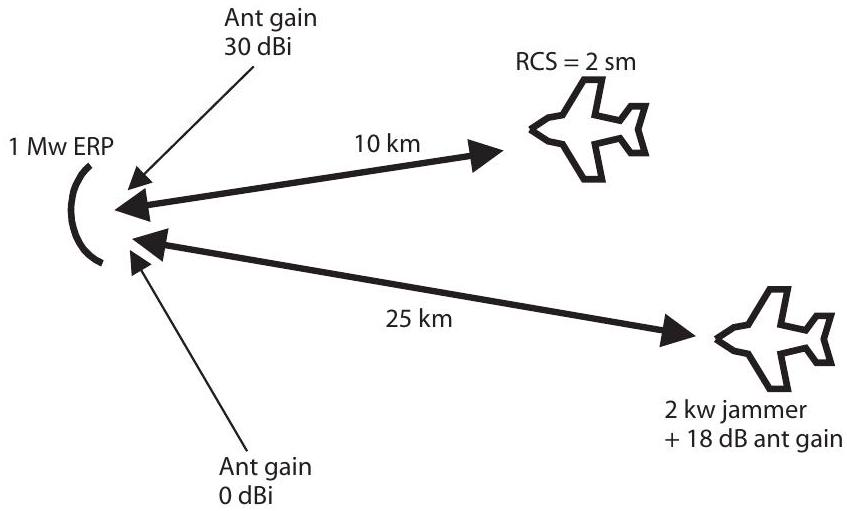
问题101-34: 计算上述雷达、目标和远程干扰机(standoff jammer)的烧穿距离。
注意,烧穿距离是指雷达到目标的距离。远程干扰机与雷达的距离保持不变。所需 \(\mathrm{J}/\mathrm{S}=0\ \mathrm{dB}\)。
解远程干扰 J/S 方程求 \(40\log(D_T)\):
\[
\begin{gathered}
40 \log(D_T) = -71 - P_J + P_T - G_J - G_{RJ} + 2 G_R + 20 \log(D_J) + 10 \log(\mathrm{RCS}) + \mathrm{J}/\mathrm{S} \\
= -71 - 63 + 60 - 18 - 0 + 60 + 28 + 3 + 0 = -1 \\
D_T = \operatorname{antilog}[-1/40] = 0.944\ \mathrm{km} = 944\ \mathrm{m}
\end{gathered}
\]
问题101-35: 若目标距离为 15 km,雷达 \(3\ \mathrm{dB}\) 波束宽度为 \(2^{\circ}\),脉冲宽度为 \(2\ \mu\mathrm{s}\),求雷达分辨单元(resolution cell)的尺寸。
单元深度:
\[
0.5 \times (c \times \mathrm{PW}) = 0.5 \times 3 \times 10^8 \times 2 \times 10^{-6} = 300\ \mathrm{m}
\]
单元宽度:
\[
2 R \sin(\mathrm{BW}/2) = 2 \times 15{,}000 \times \sin(1^{\circ}) = 2 \times 15{,}000 \times 0.0175 = 524\ \mathrm{m}
\]
问题101-36: 若一个主动诱饵(active decoy)接收 5 GHz 信号功率为 -30 dBm,并发射 1 kW 返回信号,其模拟的 RCS 为多少?
\[
1\ \mathrm{kW} = +60\ \mathrm{dBm}
\]
有效增益为:
\[
+60\ \mathrm{dBm} - (-30\ \mathrm{dBm}) = 90\ \mathrm{dB}
\]
\[
\begin{aligned}
\operatorname{RCS}(\mathrm{dBsm}) &= 39 + G - 20\log(F) = 39 + 90 - 20\log(5{,}000) \\
&= 39 + 90 - 74 = 55\ \mathrm{dBsm} \\
\operatorname{RCS}(\mathrm{m}^2) &= \operatorname{antilog}(55/10) = 316{,}000\ \mathrm{m}^2
\end{aligned}
\]
第2部分:EW 102 书中的问题
这些问题均来自本书内容。列出的章节号为书中公式和说明所在章节。
问题102-1: 计算脉冲重复频率为 5,000 脉冲/秒的雷达的最大无歧义距离。
\[
\begin{aligned}
& \text{PRI} = 1 / \mathrm{PRF} = 1 / 5{,}000\ \text{秒}^{-1} = 200\ \mu\mathrm{s} \\
& R_{\mathrm{MAX}} = 0.5 \times \mathrm{PRI} \times c = 0.5 \times 2 \times 10^{-4}\ \mathrm{秒} \times 3 \times 10^8\ \mathrm{m/s} = 30{,}000\ \mathrm{m} \\
& = 30\ \mathrm{km}
\end{aligned}
\]
问题102-2: 计算脉冲宽度为 \(10\ \mu\mathrm{s}\) 的雷达最小探测距离。
\[
R_{\mathrm{MIN}} = 0.5 \times \mathrm{PW} \times c = 0.5 \times 10^{-5}\ \mathrm{秒} \times 3 \times 10^8\ \mathrm{m/s} = 1{,}500\ \mathrm{m} = 1.5\ \mathrm{km}
\]
问题 102-3:计算一个雷达接收信号能量,该雷达的峰值功率为 \(1\text{ kW}\),占空比为 \(10\%\),主波束峰值增益为 \(30\text{ dB}\),工作频率为 5 GHz,波束宽度为 \(2^{\circ}\),在 5 秒的圆形扫描中,对一个位于 50 km 处、雷达截面积为 \(1\text{ m}^{2}\) 的目标。
平均功率为 \(100\text{ kW} \times 0.1 = 10\text{ kW}\)。
波长 \((\lambda) = c / F = 3 \times 10^{8}\text{ m/s} / 5 \times 10^{9}\text{ Hz} = 0.1\text{ m}\)。
天线增益 \((30\text{ dB}) = 1000\)。
照射时间等于目标在雷达波束中的时间。
目标在波束中的时间为 \(\left(2^{\circ} / 360^{\circ}\right) \times 5\text{ s} = 27.8\text{ ms}\)。
(注意,这假设在波束照射期间距离变化不显著。)
$$
\begin{aligned}
& \mathrm{SE} = \frac{P_{\mathrm{AVE}} G^{2} \sigma \lambda^{2} T_{\mathrm{OT}}}{(4 \pi)^{3} R^{4}} \
& = \frac{10\text{ kW} \times 10^{6} \times 1\text{ m}^{2} \times 0.01\text{ m}^{2} \times 2.7 \times 10^{-2}\text{ s}}{1.98 \times 10^{3} \times 6.25 \times 10^{6}} \
& = 2.7 \times 10^{6} / 1.23 \times 10^{10} = 2.2 \times 10^{-4}\text{ 瓦秒}
\end{aligned}
$$
问题 102-4:使用分贝公式计算问题 102-3 中描述的雷达接收机的输入功率。
峰值功率为 \(1\text{ kW} = +60\text{ dBm}\)
\[
\begin{aligned}
& P_{R} = -103 + P_{T} + 2G - 20 \log_{10}(F) - 40 \log_{10}(d) + 10 \log_{10}(\sigma) \\
& = -103 + 80 + 60 - 20 \log(5,000) - 40 \log(50) + 10 \log(1) \\
& = -103 + 80 + 60 - 74 - 68 + 0 = -105\text{ dBm}
\end{aligned}
\]
问题 102-5:计算问题 102-3 中描述的雷达目标反射功率与到达目标功率的比值。
目标反射功率 / 到达目标功率实际上是一种增益 \((G)\)
\[
\begin{aligned}
& G = -39 + 20 \log(F) + 10 \log(\mathrm{RCS}) = -39 + 20 \log(5,000) + 10 \log(1) \\
& = -39 + 74 + 0 = 35\text{ dB}
\end{aligned}
\]
注意,入射信号和反射信号强度都已归一化为目标表面上的理想各向同性天线——信号并没有因为从目标反射而真正增大。
问题 102-6:确定问题 102-3 中描述的雷达和目标的探测距离。假设雷达接收机灵敏度(包括处理增益)为 -100 dBm。
将接收功率设为灵敏度,并求解 \(40 \log(d)\):
\[
\begin{aligned}
& 40 \log(d) = -103 + P_{T} + 2G - 20 \log(F) + 10 \log(\sigma) - \text{Sens} \\
& = -103 + 80 + 60 - 74 + 0 - (-100) = 63 \\
& d = 10^{[40 \log(d) / 40]} = \operatorname{antilog}(63 / 40) = \operatorname{antilog}(1.575) = 37.6\text{ km}
\end{aligned}
\]
问题 102-7:计算一个带宽为 \(20\text{ MHz}\)、噪声系数为 \(10\text{ dB}\)、要求信噪比为 \(13\text{ dB}\) 的 RWR 的灵敏度。
\[
\begin{aligned}
& kTB = -114 + 10 \log(20\text{ MHz} / 1\text{ MHz}) = -114 + 13 = -101 \\
& \text{Sensitivity} = kTB + \text{NF} + \text{SNR} = -101 + 10 + 13 = -78\text{ dBm}
\end{aligned}
\]
问题 102-8:确定一个灵敏度为 -45 dBm、天线增益为 -3 dBi 的 RWR 能够探测问题 102-3 中描述的雷达(在其主波束峰值处)的距离。
\[
\begin{aligned}
& 20 \log(d) = P_{T} + G_{M} - 32 - 20 \log(F) + G_{R} - \text{Sens} \\
& = 80 + 30 - 32 - 74 + 3 - (-45) = 52 \\
& d = 10^{[20 \log(d) / 20]} = \operatorname{antilog}(52 / 20) = \operatorname{antilog}(2.6) = 398\text{ km}
\end{aligned}
\]
问题 102-9:确定一个带有 -10 dBi 天线、\(10\text{ MHz}\) 带宽、\(3\text{ dB}\) 噪声系数、要求信噪比为 \(13\text{ dB}\) 的 ELINT 接收机,在 \(0\text{ dB}\) 旁瓣下探测问题 102-3 中雷达的距离。
\[
\begin{gathered}
kTB = -114 + 10 \log(10) = -104 \\
\text{Sens} = kTB + \text{NF} + \text{SNR} = -104 + 3 + 13 = -88\text{ dBm}
\end{gathered}
\]
\[
\begin{gathered}
20 \log(d) = P_{T} + G_{SL} - 32 - 20 \log(F) + G_{R} - \text{Sens} \\
= 80 + 0 - 32 - 74 - 10 - (-88) = 52 \\
d = 10^{[20 \log(d) / 20]} = \operatorname{antilog}(52 / 20) = \operatorname{antilog}(2.6) = 398\text{ km}
\end{gathered}
\]
问题 102-10:当目标以 \(200\text{ m/s}\) 直接接近固定雷达,工作频率为 10 GHz 时,计算雷达接收到的多普勒频移。
\[
\Delta F = 2(V / c) F = 2 \left(200 / 3 \times 10^{8}\right) 10^{10} = 13.333\text{ kHz}
\]
问题 102-11:当单站定位器的仰角为 \(35^{\circ}\)、电离层高度为 100 km 时,计算到目标发射机的地表距离。
\[
35^{\circ} = 0.6109 \text{ 弧度}
\]
地球半径为 \(6,371\text{ km}\)。
\[
\begin{aligned}
& d = 2R \left( \pi/2 - B_{R} - \sin^{-1} \left[ \frac{R \cos B_{R}}{R + H} \right] \right) \\
& = 2 \cdot 6,371 \left[ \pi/2 - 0.6109 - \arcsin \left( \frac{6,371 \cos(35^{\circ})}{6,371 + 100} \right) \right] \\
& = 12,742 \left[ 0.9599 - \arcsin(0.8063) \right] = 12,742 \cdot [0.9599 - 0.9379] = 276\text{ km}
\end{aligned}
\]
问题102-12: 计算 2 GHz 信号在 15 km 处的视距衰减。
\[
\begin{aligned}
& L_{S}=32+20 \log (F)+20 \log (d) \\
& =32+20 \log (2,000)+20 \log (15)=32+66+24=122 \mathrm{~dB}
\end{aligned}
\]
问题 102-13:计算从 2 米高的天线发射并由 200 米高的天线接收的 120 MHz 信号的弗涅尔区距离。
\[
\begin{aligned}
& \mathrm{FZ}(\mathrm{~km})=\left(h_{T} \times h_{R} \times F\right) / 24,000=(2 \times 200 \times 120) / 24,000 \\
& =48,000 / 24,000=2 \mathrm{~km}
\end{aligned}
\]
问题 102-14:若路径长度为 15 km,计算问题 102-13 中信号的扩展损耗。
路径长度大于弗涅尔区距离,因此适合使用双射线模型。
\[
\begin{aligned}
& L_{S}=120+40 \log (d)-20 \log \left(h_{T}\right)-20 \log \left(h_{R}\right)=120+47-6-46 \\
& =115 \mathrm{~dB}
\end{aligned}
\]
问题 102-15:计算刀刃衍射损耗,对于一个 \(150\text{ MHz}\) 信号,发射机到刀刃的距离为 10 km,接收机到刀刃的距离为 50 km。刀刃比发射机和接收机之间的视距高 100 m。
使用图 5.9 的示意图计算此损耗。
首先,计算归一化距离 "\(d\)":
\[
\begin{aligned}
& d=\left[\operatorname{sqrt}(2) /\left(1+d_{1} / d_{2}\right)\right] d_{1}=1.414 /(1+10 / 50) 10 \mathrm{~km} \\
& =[1.414 / 1.2] \times 10 \mathrm{~km}=11.8 \mathrm{~km}
\end{aligned}
\]
根据示意图,刀锋衍射附加损耗(视距损耗之外)为 13.5 dB。
问题 102-16:250 MHz 时各向同性(即 0-dBi 增益)天线的有效面积是多少?
- (第 5.4 节)
\[
\begin{aligned}
& A(\mathrm{dBsm})=39+G-20 \log (F)=39+0+20 \log (250) \\
& =39+0-48=-9 \mathrm{dBsm} \\
& \text { Area }\left(\text { in m }^{2}\right)=\operatorname{antilog}(-9 / 10)=0.13 \mathrm{~m}^{2}
\end{aligned}
\]
问题 102-17:在 500 MHz 处标称为 \(15\ \mu\mathrm{V}/\mathrm{m}\) 的接收机,其灵敏度为多少 dBm?
\[
\begin{aligned}
& P=-77+20 \log (E)-20 \log (F)=-77+20 \log (15)-20 \log (500) \\
& =-77+24-54=-107 \mathrm{dBm}
\end{aligned}
\]
问题 102-18:在 150 MHz 处标称灵敏度为 -100 dBm 的接收机,其以微伏每米表示的灵敏度是多少?
\[
\begin{aligned}
& E=\operatorname{antilog}\{[P+77+20 \log (F)] / 20\} \\
& =\operatorname{antilog}\{[-100+77+20 \log (150)] / 20\} \\
& =\operatorname{antilog}\{[-100+77+44] / 20\}=\operatorname{antilog}\{1.05\}=11.2 \mu \mathrm{v} / \mathrm{m}
\end{aligned}
\]
问题 102-19:用 8 位量化对信号进行数字化时,量化噪声对应的信噪比是多少?
\[
\operatorname{SNR}(\mathrm{dB})=5+3(2 m-1)=5+3(15)=50 \mathrm{~dB}
\]
问题 102-20:8 位模数转换器的动态范围(DR)是多少?
\[
\mathrm{DR}=20 \log \left(2^{m}\right)=20 \log (256)=48 \mathrm{~dB}
\]
问题 102-21:对于预检波(predetection)信噪比为 22 dB、比特率为 10,000 bit/s、带宽为 20 kHz 的信号,计算 \(E_{b}/N_{0}\)。
\[
E_{b} / N_{0}(\mathrm{~dB})=\mathrm{RFSNR}+10 \log (\text{bandwidth}/\text{bit rate})=22\ \mathrm{dB}+10 \log (20\mathrm{k}/10\mathrm{k})=22+3=25\ \mathrm{dB}
\]
问题 102-22:若一个等效辐射功率(ERP)为 1 kW 的干扰机距离接收机 50 km,接收机天线为 360° 全向,而目标发射机 ERP 为 10 W、距接收机 10 km;发射机、干扰机与接收机均处于微波频段且均远离地面,那么实现的 \(\mathrm{J}/\mathrm{S}\) (干扰对信号比)是多少?
接收天线对干扰机的增益与对目标发射机相同,因此两项增益相互抵消。
\[
\begin{aligned}
& \quad 1 \mathrm{kw} \text { is }+60 \mathrm{dBm} \quad 1 \mathrm{~W} \text { is }+30 \mathrm{dBm} \\
& \mathrm{~J} / \mathrm{S}=\mathrm{ERP}_{\mathrm{J}}-\mathrm{ERP}_{\mathrm{S}}+20 \log \left(d_{S}\right)-20 \log \left(d_{J}\right)+G_{R J}-G_{R} \\
& =\mathrm{ERP}_{\mathrm{J}}-\mathrm{ERP}_{\mathrm{S}}+20 \log \left(d_{S}\right)-20 \log \left(d_{J}\right) \\
& =60-30+20 \log (10)-20 \log (50)=60-30+20-34=16 \mathrm{~dB}
\end{aligned}
\]
问题 102-23:一个 10-W ERP、150-MHz 的发射机和一个接收机的有效天线高度均为 2 m,相距 10 km;发射和接收天线均为 360° 全向。一个 1-kw ERP 的干扰机的有效天线高度为 200 m,距离接收机 50 km。实现的 \(\mathrm{J}/\mathrm{S}\) 是多少?
(第 5.8.2 节)
首先必须计算发射机链路和干扰机链路的弗涅尔区(FZ)范围。
\[
\mathrm{FZ}(\mathrm{~km})=\left(h_{T} \times h_{R} \times F\right) / 24,000
\]
对于发射机,\(\mathrm{FZ}=(2 \times 2 \times 150) / 24.000=250 \mathrm{~m}\)
对于干扰机,\(\mathrm{FA}=(200 \times 2 \times 150) / 24,000=2.5 \mathrm{~km}\)
两条链路长度都需要采用双射线传播模型。
\[
\begin{aligned}
& \mathrm{J} / \mathrm{S}=\mathrm{ERP}_{\mathrm{J}}-\mathrm{ERP}_{\mathrm{S}}+40 \log \left(d_{S}\right)-40 \log \left(d_{J}\right)+20 \log \left(h_{J}\right)-20 \log \left(h_{S}\right) \\
& +G_{R J}-G_{R}
\end{aligned}
\]
由于接收天线对发射机与干扰机的增益相同,两项增益相互抵消。
\[
\begin{gathered}
10 \mathrm{~W}=+40 \mathrm{dBm} \quad 1 \mathrm{kw}=+60 \mathrm{dBm} \\
\mathrm{~J} / \mathrm{S}=\mathrm{ERP}_{\mathrm{J}}-\mathrm{ERP}_{\mathrm{S}}+40 \log \left(d_{S}\right)-40 \log \left(d_{J}\right)+20 \log \left(h_{J}\right)-20 \log \left(h_{S}\right) \\
=60-40+40 \log (10)-40 \log (50)+20 \log (200)-20 \log (2) \\
=60-40+40-68+46-6=32 \mathrm{~dB}
\end{gathered}
\]
问题 102-24:对于一个直接序列扩频(direct sequence spread spectrum)信号,芯片率为 \(1\ \mathrm{Mbps}\),比特率为 \(1\ \mathrm{Kbps}\),系统损耗为 \(0\ \mathrm{dB}\),并且要求输出信噪比为 \(15\ \mathrm{dB}\),其抑干余量(jamming margin)是多少?
用于扩频的码率是芯片率,它是比特率的 1,000 倍,因此处理增益为 30 dB。抑干余量(jamming margin)为:
\[
M_{J}=G_{P}-L_{S Y S}-\mathrm{SNR}_{\mathrm{OUT}}=30 \mathrm{~dB}-0 \mathrm{~dB}-15 \mathrm{~dB}=15 \mathrm{~dB}
\]
问题 102-25:一个频率跳变发射机向 2 m 高、2-dB 天线发射 10 W 功率。一个同步接收机配备 2-dB(鞭状)天线,距离 7 km(天线高 2 m)。跳频信道宽 25 kHz,跳频范围 58 MHz。一个可变带宽 2-kw 噪声干扰机向接收机发射,配备 12-dB 对数周期天线,高度 30 m,距离 20 km。适合使用双射线传播模型。求最优干扰带宽及被干扰的接收信道数。
\[
\mathrm{ERP}_{\mathrm{J}}=+63+12=+75 \mathrm{dBm} \quad \mathrm{ERP}_{\mathrm{S}}=+40+2=+42 \mathrm{dBm}
\]
来自目标发射机的接收功率为:
\[
\begin{aligned}
& P_{R}=\mathrm{ERP}_{\mathrm{S}}-\left[120+40 \log (d)-20 \log \left(h_{T}\right)-20 \log \left(h_{R}\right)\right]+G_{R} \\
& =\mathrm{ERP}_{\mathrm{S}}-120-40 \log (d)+20 \log \left(h_{T}\right)+20 \log \left(h_{R}\right)+G_{R} \\
& =42-120-40+6+6+2=-104 \mathrm{dBm}
\end{aligned}
\]
由于频率跳变信号为数字信号,最优 \(\mathrm{J}/\mathrm{S}=0\ \mathrm{dB}\),因此干扰机应在每个接收信道注入 -104 dBm。
跳频覆盖 58 MHz,每个信道宽 25 kHz,总共有 2,320 个跳频信道。
接收机接收到的总干扰功率为:
 $$
\begin{aligned}
& P_{R J}=\mathrm{ERP}{\mathrm{J}}-\left[120+40 \log \left(d \
& =75-120-40 \log (50)+20 \log (30)+20 \log (2)+2 \
& =75-120-68+30+6+2=-75 \mathrm{dBm}
\end{aligned}
$$}\right)-20 \log \left(h_{J}\right)-20 \log \left(h_{R}\right)\right]+G_{R J
$$
\begin{aligned}
& P_{R J}=\mathrm{ERP}{\mathrm{J}}-\left[120+40 \log \left(d \
& =75-120-40 \log (50)+20 \log (30)+20 \log (2)+2 \
& =75-120-68+30+6+2=-75 \mathrm{dBm}
\end{aligned}
$$}\right)-20 \log \left(h_{J}\right)-20 \log \left(h_{R}\right)\right]+G_{R J
\(\mathrm{J}/\mathrm{S}\) 为 \(-75-(-104)=29 \mathrm{~dB}\)
29 dB 对应的倍数为 \(\text{antilog}(29/10)=794\)
最优干扰带宽为 \(794 \times 25\ \mathrm{kHz}=19.85\ \mathrm{MHz}\)。
如果干扰噪声均匀分布在 794 个信道上,每个信道的 \(\mathrm{J}/\mathrm{S}\) 为 0 dB,当跳频信号落在该信道上时。
被干扰信道的比例为 \(794 / 2,320 = 34.2\%\)。由于数字信号通常认为 33% 的干扰占空比已足够,因此该干扰机有效。
注意,也可以使用公式:
\[
\mathrm{J}/\mathrm{S} = \mathrm{ERP}_{\mathrm{J}}-\mathrm{ERP}_{\mathrm{S}}+40 \log (d_{S})-40 \log (d_{J})+20 \log (h_{J})-20 \log (h_{S})
\]
直接计算 J/S,然后将频率扩展到足够的信道数,使每个信道的 J/S 降低 29 dB。
问题 102-26:如果在整个频率范围内随机选取频率,并在 \(360^{\circ}\) 方位角上随机选取方向,求以下(数据量较小)数据集的均方根误差(RMS error)、标准差和平均误差。所有数据点均为到达角真实值的测量误差(单位:度)。
\[
1.1,-2.0,+0.5,+0.7,-3.3,-0.2,+1.2,+8,-0.1,+1.7
\]
首先,通过平均误差值计算平均误差:
\[
\text { Mean error }=\text { sum of errors } / 10=7.6 / 10=+0.76^{\circ}
\]
接着对每个误差值平方并取平均,再对平均值开平方。
\[
1.21,4,0.25,0.49,10.89,0.04,1.44,64,0.01,2.89
\]
平方和为 85.22,平方误差的平均值为 8.522,均方根(RMS)误差为 \(2.92^{\circ}\)。
标准差(即若从每个测量误差中减去平均误差后的 RMS)为:
\[
\sigma=\operatorname{sqrt}\left[\mathrm{RMS}^{2}-\text { mean }^{2}\right]=2.92^{2}-0.76^{2}=\operatorname{sqrt}[7.95]=2.81^{\circ}
\]
问题 102-27:计算静止卫星与地面站之间的扩展损耗,其中卫星位于地平线上方 \(5^{\circ}\),信号频率为 5 GHz。
从卫星到上述地面站的路径长度为 \(41,408 \mathrm{~km}\)。
\[
\begin{aligned}
& L_{S}=32+20 \log (F)+20 \log (d)=32+20 \log (5,000)+20 \log (41,408) \\
& =32+74+92=198 \mathrm{~dB}
\end{aligned}
\]
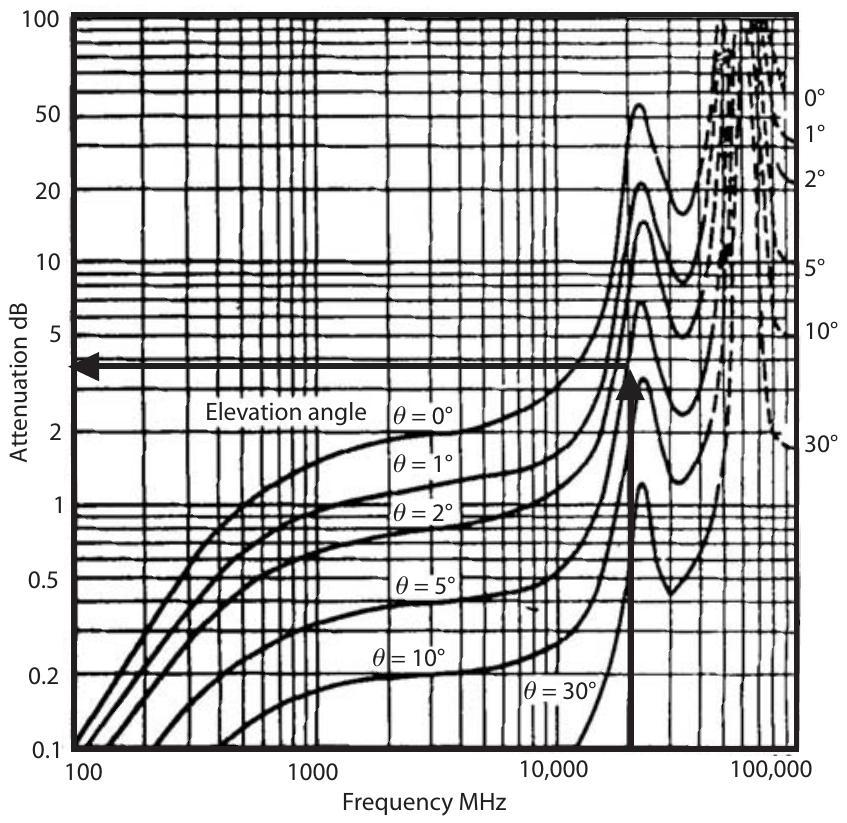
问题 102-28:求从地面站到卫星的 15-GHz 链路的大气损耗,卫星仰角为 \(5^{\circ}\)。
使用图 7.9 中的图表,从横坐标的 \(15,000 \mathrm{MHz}\) 处向上画一条垂直线,直到 \(5^{\circ}\) 仰角曲线。然后从该点向纵坐标画一条水平线,并读取链路的总大气损耗。
3.5 dB
问题 102-29:求 10 GHz 地面链路在 25 km 中等雨量情况下的雨衰。
使用表 7.4,确定图 7.8 中应使用的曲线(曲线 C)。在图 7.8 的横坐标 10 GHz 处画垂直线至曲线 C,再画水平线到纵坐标,读取每公里的雨衰。
该链路的雨衰为 \(0.05 \mathrm{~dB} / \mathrm{km} \times 25 \mathrm{~km}=1.25 \mathrm{~dB}\)。
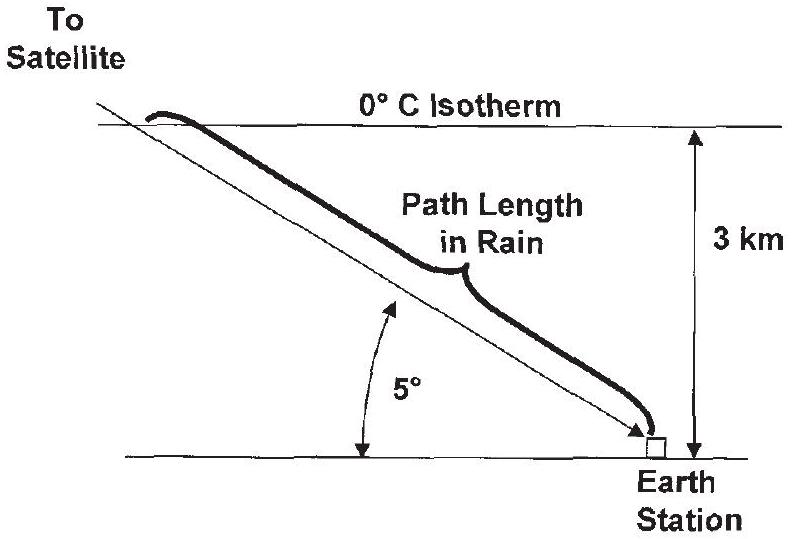
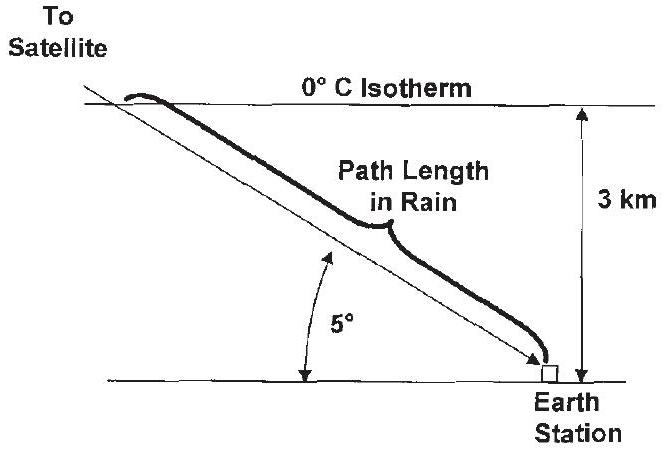
问题 102-30:求 10 GHz 卫星到地面站链路的雨衰,卫星仰角为 \(5^{\circ}\),经过中等雨区。\(0^{\circ}\) 等温线高度为 3 km。
通过雨区的路径从 \(0^{\circ}\) 等温线到地面站:
\[
d_{R}=H_{0 \mathrm{deg}} / \sin \mathrm{El}=3 \mathrm{~km} / \sin \left(5^{\circ}\right)=3 \mathrm{~km} / 0.0872=34.4 \mathrm{~km}
\]
根据问题 102-29,雨衰为 \(0.05 \mathrm{~dB} / \mathrm{km}\)。
雨衰为 \(0.05 \mathrm{~dB} / \mathrm{km} \times 34.4 \mathrm{~km}=1.7 \mathrm{~dB}\)。
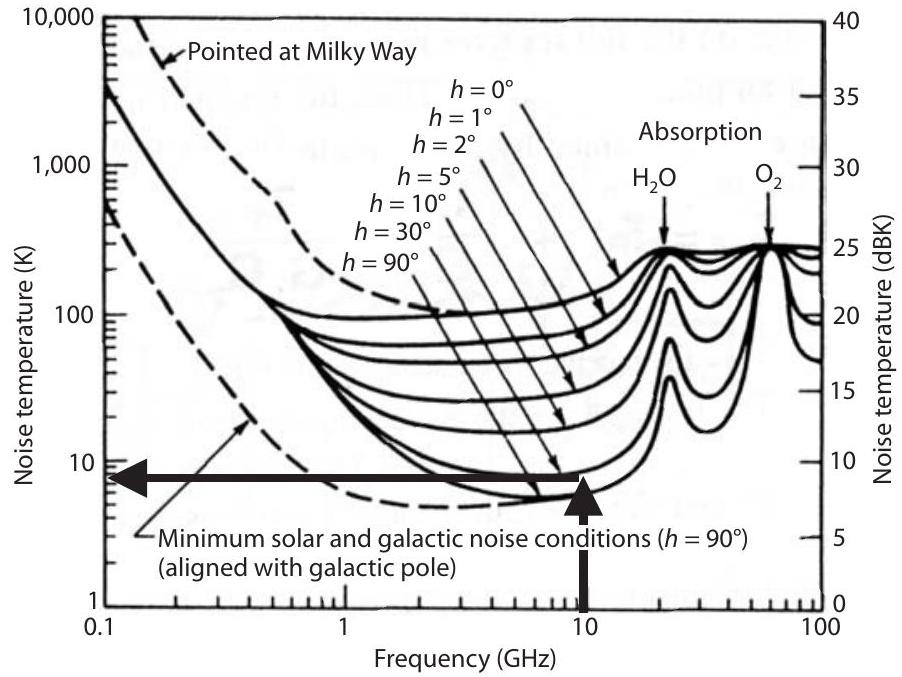
问题 102-31:计算地面站系统噪声温度,接收天线仰角 \(30^{\circ}\),工作频率 10 GHz,线路损耗 6 dB,接收机噪声系数 2 dB,环境温度 290 K。
从图 7.2 中确定天线温度。在横坐标 10 GHz 处向上画线至 30° 仰角曲线,再向左到纵坐标,读取天线温度(8 K)。
\[
\begin{aligned}
& \text { 线路温度: } T_{\text {LINE }}=\left[10^{(L / 10)}-1\right] T_{M}=\left[10^{6 / 10}-1\right] 290 \mathrm{~K} \\
& =[\operatorname{antilog}(6 / 10)-1] \times 290 \mathrm{~K}=[4-1] \times 290 \mathrm{~K}=870 \mathrm{~K}
\end{aligned}
\]
接收机噪声温度为 \(T_{R}\left[10^{(\mathrm{NF} / 10)}-1\right]\)
\[
\begin{aligned}
& =290[\operatorname{antilog}(\mathrm{NF} / 10)-1]=290[\operatorname{antilog}(2 / 10)-1] \\
& =290[1.58-1]=170 \mathrm{~K}
\end{aligned}
\]
$$
T_{S}=T_{\mathrm{ANT}}+T_{\mathrm{LINE}}+T_{\mathrm{RX}}=8 \mathrm{~K}+870 \mathrm{~K}+170 \mathrm{~K}=1,048 \mathrm{~K}
$$
问题 102-32:如果上行链路 \(\mathrm{EIRP}=55 \mathrm{dBW}\),链路损耗(包括扩展损耗、大气损耗和雨衰)为 200 dB,接收天线增益为 45 dB,卫星链路接收机的系统噪声温度为 900 K,计算卫星上的 \(\mathrm{C} / \mathrm{T}\)。
为了求 \(\mathrm{G} / \mathrm{T}\),先将天线增益转换为非分贝形式,然后除以系统温度,再转换回分贝。
\[
\begin{aligned}
& 45 \mathrm{~dB} \text { is } \operatorname{antilog}(45 / 10)=31,622 \\
& \mathrm{G} / \mathrm{T}_{\mathrm{S}}=31,622 / 900=35.1 \quad \text { which is } 15.5 \mathrm{dBi} / \mathrm{K} \\
& \mathrm{C} / \mathrm{T}=\mathrm{EIRP}-L+\mathrm{G} / \mathrm{T}_{\mathrm{S}}=55 \mathrm{dBW}-200 \mathrm{~dB}+15.5 \mathrm{dBi} / \mathrm{K} \\
& =55-200+15.5=-129.5 \mathrm{dBW} / \mathrm{K}
\end{aligned}
\]
问题 102-33:如果下行链路 EIRP 为 60 dBW,链路损耗为 204 dB,地面站接收天线增益为 30 dB,地面站系统噪声温度为 600 K,计算地面站的 \(\mathrm{C} / \mathrm{T}\)。
\[
\mathrm{G} / \mathrm{T}_{\mathrm{S}}=\operatorname{antilog}(30 / 10) / 600=1.7 \mathrm{dBi} / \mathrm{K}
\]
\[
\mathrm{C} / \mathrm{T}=\mathrm{EIRP}-L+\mathrm{G} / \mathrm{T}_{\mathrm{S}}=60 \mathrm{dBW}-204 \mathrm{~dB}+1.7=-142 \mathrm{dBW} / \mathrm{K}
\]
问题 102-34:如果传输数据的带宽为 5 MHz,上行链路和下行链路(问题 102-32 和 102-33)的综合信噪比是多少?
综合 \(\mathrm{C} / \mathrm{T}\) 的倒数等于上行和下行 \(\mathrm{C} / \mathrm{T}\) 值倒数之和——在相加之前必须先转换回线性形式。
\[
\mathrm{C} / \mathrm{T}_{\text{up}}=-140 \mathrm{dBW} / \mathrm{K}=\operatorname{antilog}(-130 / 10)=1 \times 10^{-13}
\]
\[
\mathrm{C} / \mathrm{T}_{\text{down}}=-91 \mathrm{dBW} / \mathrm{K}=\operatorname{antilog}(-142 / 10)=6.3 \times 10^{-15}
\]
\[
1 / \mathrm{C} / \mathrm{T}_{\text{combined}} = 1 / \mathrm{C} / \mathrm{T}_{\text{up}} + 1 / \mathrm{C} / \mathrm{T}_{\text{down}} = 10^{13} + 1.6 \times 10^{14} = 1.685 \times 10^{14}
\]
\[
\mathrm{C} / \mathrm{T}_{\text{combined}} = 5.9 \times 10^{-15} = -142.2 \mathrm{dBW} / \mathrm{K}
\]
\[
\mathrm{C} / \mathrm{kT} = \mathrm{C} / \mathrm{T} - kT = -142.2 + 228.6 = 86.4 \mathrm{dBHz}
\]
\[
\mathrm{C} / \mathrm{N} = \mathrm{C} / \mathrm{kT} - 10 \log (\text{BW in Hz}) = 86.4 - 10 \log \left(5 \times 10^{6}\right) = 86.4 - 67 = 19.4 \mathrm{~dB}
\]